Wax Pattern tooling is necessary for all investment castings. The tool is made from high grade aluminum, and designed to accept the flow of molten wax under extreme pressure, in order to allow it to solidify into the wax pattern which is used to form the ceramic mold during the investing process. Unlike sand casting, lost wax tooling replicates the final casting in reverse, due to the fact that we cut “cavities” in which the wax flows to form our patterns. This tooling is often designed to be “collapsible”, in other words, it must be able to be taken apart to remove the solid wax patterns when they have cooled. Another critical element of the tooling design is that the tooling must be constructed so that the wax patterns produced are larger than the final casting dimensions. This is due to the fact that metal shrinks during its solidification, so our Engineers must calculate an expected shrinkage rate for every dimension in the tool, and apply those expected shrinkage rates when cutting the tooling. In the pattern tooling, any internal features can be produced, however if the metal components of the tooling cannot be removed from the wax after solidification has taken place, a suitable method of coring will need to be utilized to form internal features.
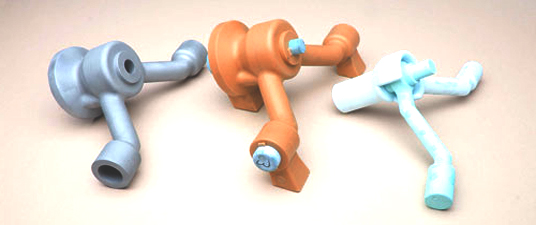
Soluble Wax Coring Tooling is not required for every investment casting, but in some cases is necessary, and is used in conjunction with the main wax tooling. In fact, this tooling looks very similar to wax pattern tooling, and is also injected with molten wax under high pressure. The difference is that the waxes produced are made from a special grade of soluble wax, which can easily be dissolved in a mild etch. This feature allows us to produce tooling to form one or more of the internal geometries of a casting as a solid wax shape, then transfer that wax to the pattern wax injection die, and the pattern wax (blue in the photograph) will be injected around the soluble wax (yellow in the photograph). After the pattern wax has solidified, we are left with a composite assemble of the two waxes fused together, and then we simply etch away the soluble wax to reveal the inner geometries.
Wax coring is utilized in applications where the resulting internal features are able to be shelled during the standard investing process. If the internal features cannot be shelled due to size and/or location, then a solid ceramic must be utilized.
Ceramic Core Tooling once again is similar to the functionality of wax tooling, however it is typically made from steel rather than aluminum for durability reasons. Ceramic core tools do not use wax injection, rather, they are filled with a ceramic slurry and allowed to dry to a solid so that the slurry forms into a solid ceramic piece (white in photograph). These ceramic cores perform the same function as the soluble wax core, in that they are placed into the wax pattern tooling, and the pattern wax is injected around them to form a composite piece (blue in photograph). However, since the core is now in place, and is already made from ceramic, there is no need to remove it, and the composite pattern can now proceed directly to the shelling operation to build the ceramic shell around the remaining outer surfaces.
Ceramic coring is the most costly coring method, and is used in applications where internal geometries need to be cast, but there is no other practical way to build the ceramic shell using standard dipping, or “investing” to form the ceramic. The completed casting seen in this photograph (grey) is an example of a component with intricate internal details that are not easily accessible for shelling, and therefore could not be cast with this level of detail without the ability to use ceramic coring.
Other Types of Tooling Used
Checking Gauges are sometimes required for castings in order to verify certain specific dimensions or characteristics of a casting during the manufacturing or inspection process. If a checking gauge is required, it will be designed and built by Cheonseng Engineers to ensure suitability for the application, or we can accept checking gauges from the customer for use in our facility.
Straightening Fixtures are usually required if a casting tends to move or distort during the casting process. The need for straightening of castings is expected in many cases due to inherent design conditions which lend some castings to be less rigid than others, and in no way causes any damage to the integrity of the casting. As with checking gauges, we are pleased to take care of the design and manufacture of any straightening fixtures required.
|